
GitOps delivery
Terminology changes should be delivered with the same care as code changes. SkeinRank supports a Terminology-as-Code direction where JSON or YAML dictionaries can be linted, reviewed, planned, and applied into governed runtime snapshots.
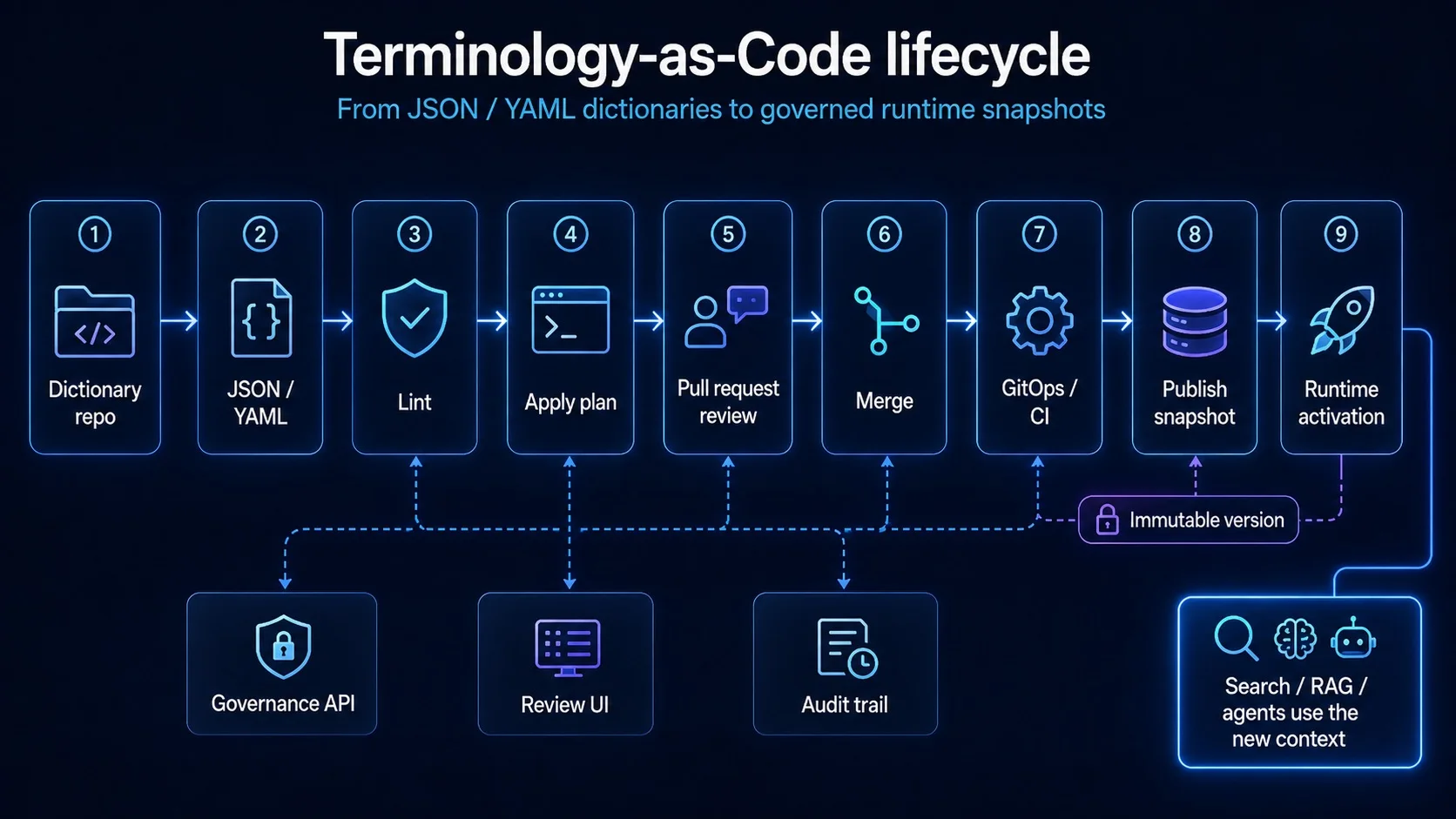
Delivery lifecycle
Section titled “Delivery lifecycle”CI checks
Section titled “CI checks”A lightweight CI pipeline should fail before merge when terminology changes are unsafe.
Example checks:
- dictionary schema is valid;
- canonical values are normalized;
- aliases are not duplicated inside a profile;
- stop-list entries do not conflict with approved aliases;
- required slots are present;
- apply plan has no destructive changes unless explicitly allowed;
- tests or fixtures still pass.
GitLab CI sketch
Section titled “GitLab CI sketch”stages: [lint, plan]
terminology:lint: stage: lint script: - skeinrank dictionary lint dictionaries/
terminology:plan: stage: plan script: - skeinrank dictionary plan dictionaries/ --output plan.json artifacts: paths: - plan.jsonThe exact CLI commands should follow the installed SkeinRank package version in your repository. Keep examples close to the package docs and avoid inventing project-specific wrapper names in production runbooks.
ArgoCD / Flux shape
Section titled “ArgoCD / Flux shape”GitOps systems should not directly mutate runtime state without validation. A safer shape is:
Dictionary PR merged ↓CI lint + plan passed ↓Deployment job calls governance API apply endpoint ↓Snapshot is published ↓Binding is activated or stagedArgoCD or Flux can deploy the service and configuration. The governance API should still own validation, audit, and snapshot publication.
Promotion environments
Section titled “Promotion environments”A practical rollout path is:
| Environment | Purpose | Binding behavior |
|---|---|---|
| Dev | Fast iteration and local demo dictionaries. | Profile-only preview is acceptable. |
| Staging | Evidence review, apply planning, and dry-run enrichment. | Bindings point to staging indexes or aliases. |
| Production | Low-noise runtime canonicalization and search/RAG context. | Bindings pin approved immutable snapshots. |
Rollback rule
Section titled “Rollback rule”GitOps should make rollback boring:
previous dictionary commit + previous snapshot + previous binding activation = recoverable runtime behaviorThat is why snapshots and bindings are separate concepts.