
Sidecar control plane
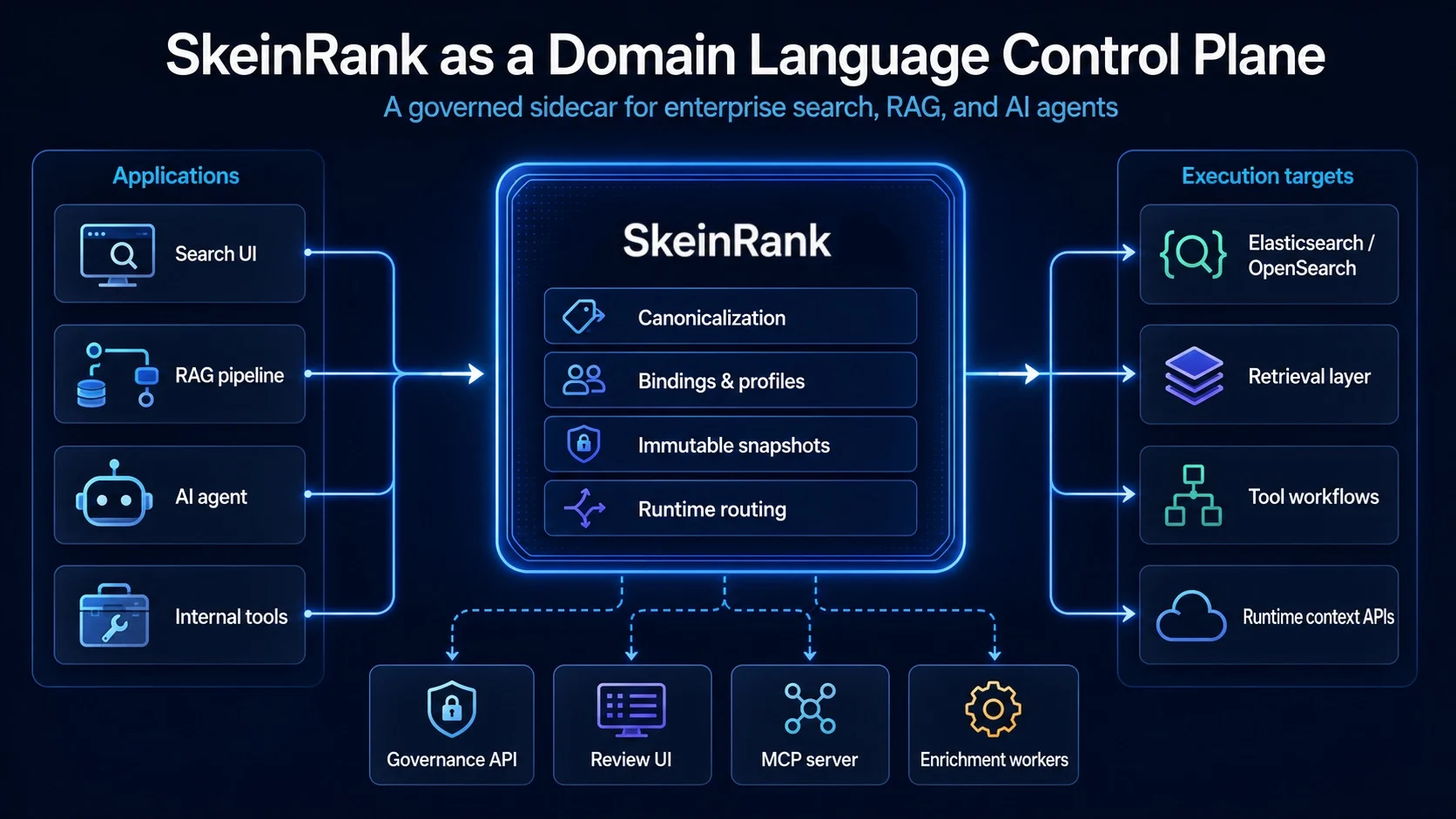
SkeinRank is designed as a sidecar control plane for domain language. It does not replace Elasticsearch, OpenSearch, vector databases, RAG orchestration, or product search UIs.
Instead, it gives those systems a governed layer for company-specific language: aliases, acronyms, canonical terms, bindings, snapshots, evidence, and runtime context.
Why sidecar
Section titled “Why sidecar”Embedding synonym rules directly in a search backend is fast at first, but it becomes hard to govern when teams need review, rollback, evidence, audit trails, and environment-specific rollout.
A sidecar model keeps the responsibilities separate:
Application
Owns user experience, authorization, workspace context, ranking UX, and result rendering.
Search / RAG stack
Owns Elasticsearch, OpenSearch, vector search, reranking, retrieval orchestration, and answer generation.
SkeinRank
Owns governed terminology, binding-aware context, snapshots, evidence review, and safe rollout of language changes.
Operators
Review suggestions, validate evidence, publish snapshots, and decide which runtime bindings are active.
Integration shape
Section titled “Integration shape”Search UI / RAG backend / AI agent ↓ chooses app or workspace scopeSkeinRank runtime API ↓ canonical query + route plan + context packageElasticsearch / OpenSearch / RAG / tool workflowThe application should usually pass a binding_id rather than a raw profile name. The binding represents where a profile applies, which fields are involved, and which snapshot is safe to use at runtime.
What SkeinRank should not own
Section titled “What SkeinRank should not own”SkeinRank should not become the entire enterprise search engine. It should not own every ranking decision, every LLM prompt, or every product-specific search page.
A clean boundary is:
SkeinRank answers: "What does this company term mean in this runtime context?"Your search/RAG stack answers: "Which documents or actions should be returned?"This lets SkeinRank remain a focused domain-language control plane that can be adopted beside existing infrastructure.
When to use this model
Section titled “When to use this model”The sidecar model is useful when:
- one acronym has different meanings across teams;
- internal aliases are scattered across code, docs, tickets, and prompts;
- search quality changes need review before rollout;
- RAG or agents need a stable context package;
- teams need to explain why a query was canonicalized;
- different indexes or tenants require different terminology snapshots.