
Binding runtime context
A profile defines terminology. A binding defines where and how that terminology is applied. A snapshot defines the immutable version that runtime consumers should use.
Profile = what the terminology meansBinding = where and how that terminology is appliedSnapshot = which immutable version is safe to serve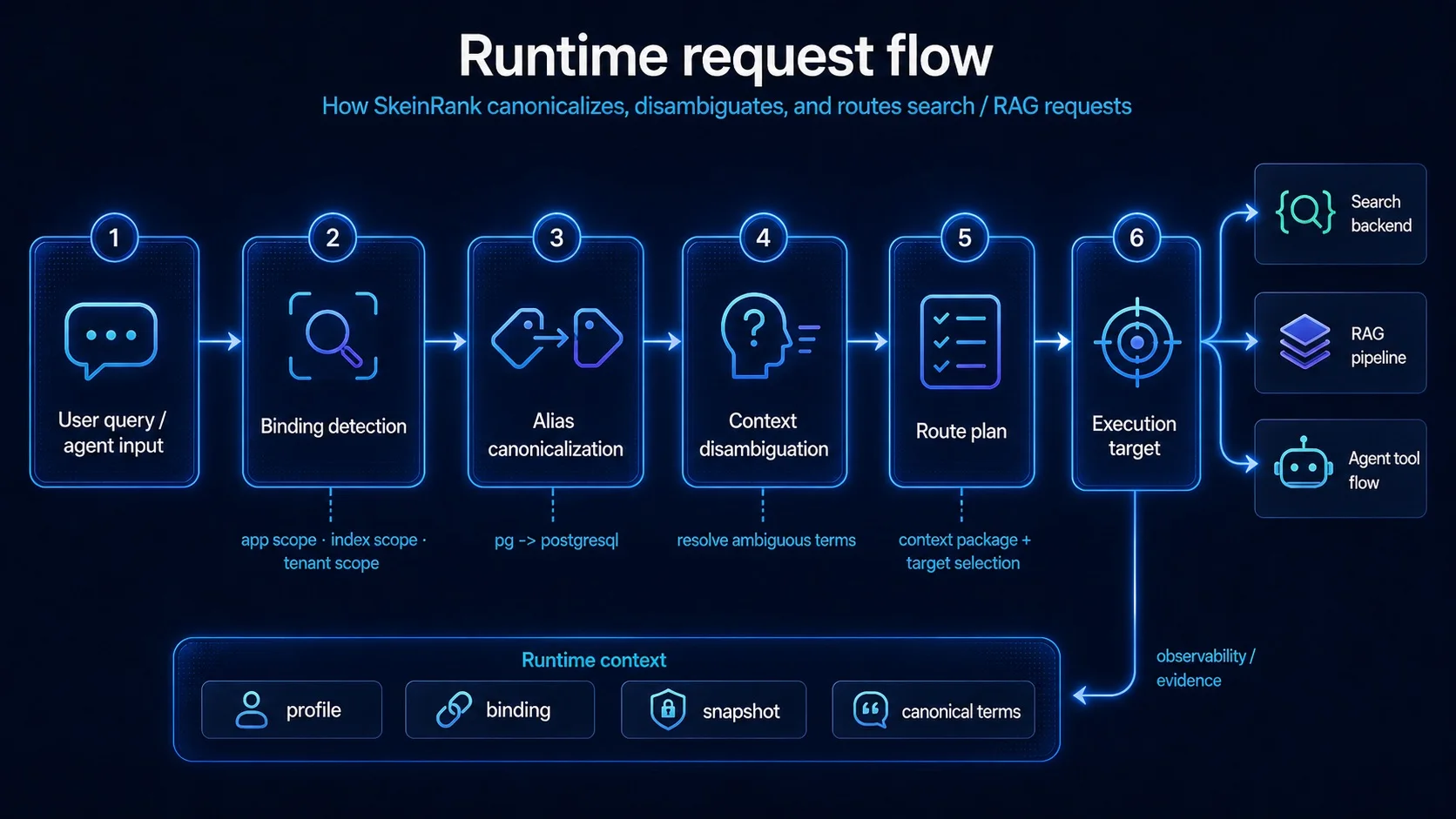
Why profiles are not enough
Section titled “Why profiles are not enough”A profile can tell SkeinRank that k8s maps to kubernetes or that pg may map to postgresql. It cannot fully answer production runtime questions such as:
- Which index or alias should be searched?
- Which text fields should be read?
- Which target field stores enrichment output?
- Which filter or discriminator scopes the documents?
- Which snapshot version is active?
- Which ambiguous alias interpretation is safe in this context?
A binding owns those runtime decisions.
Recommended request shape
Section titled “Recommended request shape”Production runtime calls should use binding_id when available:
{ "binding_id": 42, "query": "k8s pg timeout", "size": 10}The application can map product UI scopes to bindings:
| Application scope | SkeinRank binding | Runtime behavior |
|---|---|---|
| Infra incidents | infra_incidents_prod | pg can resolve to PostgreSQL. |
| Docs platform | docs_platform_prod | pg can resolve to page. |
| Product analytics | product_analytics_prod | pg can resolve to product group. |
Common binding patterns
Section titled “Common binding patterns”1 profile → 1 index
The simplest path. Create one binding and pin one runtime snapshot for that corpus.
1 profile → many indexes
Create one binding per index because each index may use different fields, rollout state, or snapshot version.
Many profiles → 1 index
Create multiple scoped bindings using a discriminator such as team, doc_type, or workspace_id.
All search
Fan out across multiple bindings and merge results, or add a router layer that selects candidate bindings.
Profile-only mode
Section titled “Profile-only mode”Profile-only requests are still useful for preview, tests, local experimentation, dictionary linting, or documentation examples. They should not be the default production integration because they do not encode runtime scope.
Use this rule:
Profile-only mode = preview / developmentBinding-aware mode = production runtimeRuntime guarantees
Section titled “Runtime guarantees”Binding-aware runtime gives operators a stronger guarantee:
same binding + same snapshot + same query = reproducible canonical contextThat guarantee is what makes rollback, evidence review, and search regression testing possible.