
Skip to content

Turn messy aliases into governed search context.

SkeinRank governs profiles, bindings, snapshots, and evidence workflows for terminology-aware enterprise search, RAG, and AI agents.

One canonical vocabulary — from your terminal to runtime.

When many AI agents work a long session, each invents its own names for the same thing — accessToken, authToken, bearer_token. By merge time the codebase speaks five dialects of itself. SkeinRank gives one deterministic, auditable terminology layer: agent-lexicon catches drift in your terminal, skeinrank governs it at runtime.

agent-lexicon
pipx install agent-lexicon
# first run inside your project
# `alex` is the short CLI alias for `agent-lexicon`
alex init
alex scan README.md docs src
alex review
alex publish

Workspace ready: lexicon/
Candidates discovered
Review inbox created
Snapshot published
            
alex init
alex scan README.md docs src
alex review
alex publish
# Workspace ready: lexicon/
# Candidates discovered
# Review inbox created
# Snapshot published
agent-lexicon · PyPI skeinrank · PyPI Apache-2.0 Zero dependencies

Start in the terminal. Scale to a runtime control plane.

The same terminology governance shows up at two moments: while agents write code, and while search, RAG, and agents run in production. You don't choose between the two projects — you grow from one into the other.

Dev-time

agent-lexicon

A deterministic terminology layer for AI agents — in your terminal.

  • Install with pipx, initialize a workspace, and get the CLI in every project
  • Resolve, guard, and detect terminology drift at merge time
  • Dependency-free, runs locally, same input → same output
  • MCP server so agents read one canonical vocabulary
Runtime

skeinrank

A control plane that governs the same vocabulary in production search.

  • Bind approved terminology to search contexts and indexes
  • Evidence-backed proposals, immutable snapshots, rollback
  • Governance console, REST API, Elasticsearch enrichment
  • Audit which version each binding is pinned to, and why

Embeddings find similarity. They do not govern your company vocabulary.

SkeinRank is not trying to replace semantic search. It gives teams a controlled language layer around it: canonical terms, aliases, evidence, owners, runtime bindings, and pinned snapshots. That is the part normal search stacks usually leave scattered across synonym files, prompts, CSVs, and tribal knowledge.

01

Make terminology explicit

Turn internal names, acronyms, and aliases into reviewed product state instead of hidden query rewrites or one-off prompt instructions.

02

Control where it applies

Bind approved language to the right search context, index, fields, filters, and snapshot so runtime systems know which interpretation is safe to use.

03

Review change before rollout

Surface new terminology and conflicts as evidence-backed proposals, then publish an immutable snapshot only after the change is accepted.

Use embeddings to retrieve meaning. Use SkeinRank to govern the vocabulary that shapes retrieval.

From domain language to runtime context.

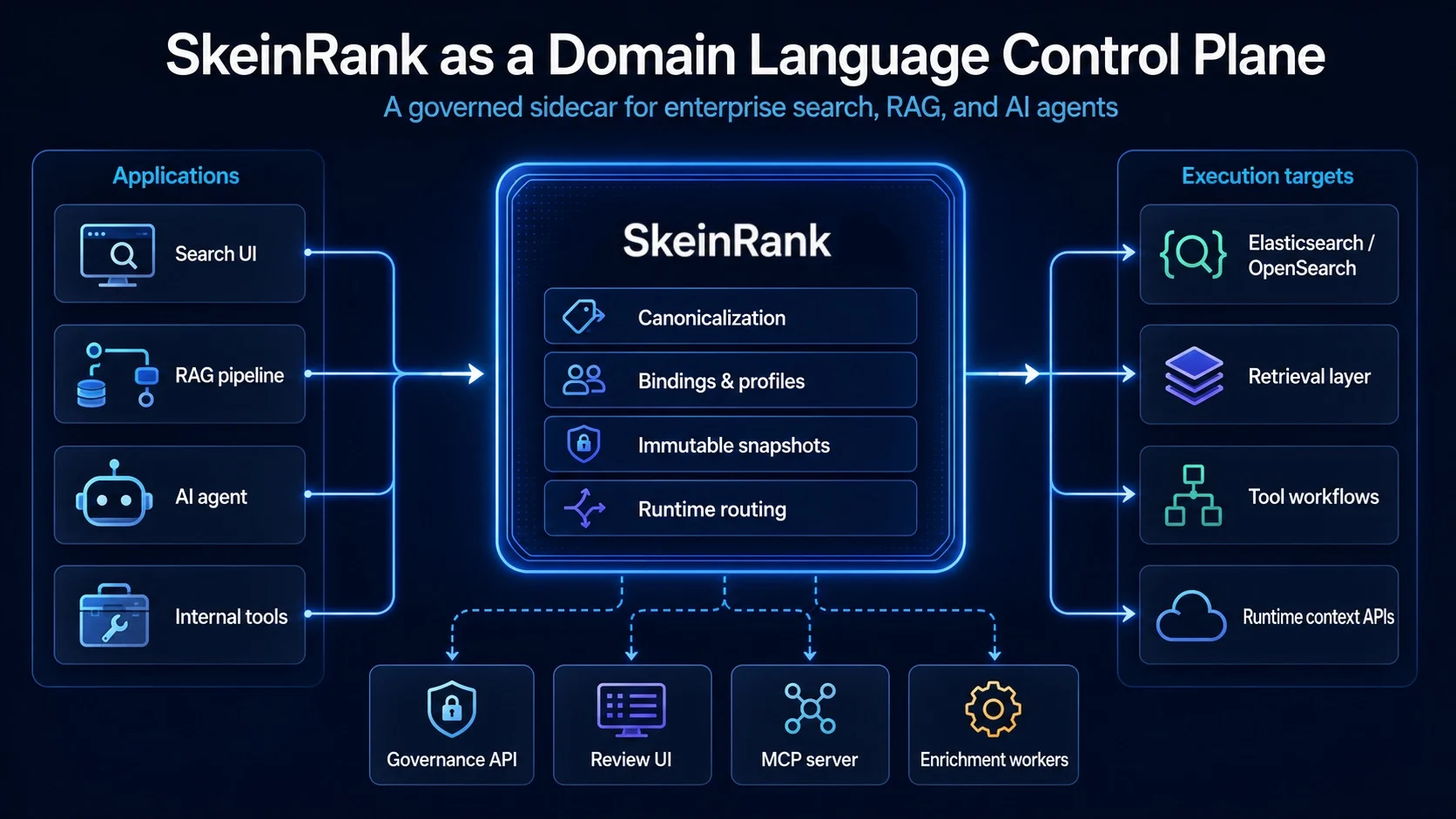
SkeinRank sits beside your existing search stack. Profiles define language, bindings select the search context, and snapshots pin the version that search, RAG, and agents can safely use.

SkeinRank control plane architecture showing applications, runtime capabilities, execution targets, and support services.
Control-plane overview: applications call SkeinRank before search, RAG, and runtime APIs consume governed context.
Runtime context binding-aware request flow

Queries can be canonicalized and routed with an explicit binding, pinned snapshot, and policy-aware context.

Governed model profiles · aliases · evidence

Domain language becomes reviewable platform state instead of hidden synonym files or prompt-only heuristics.

Integration layer MCP · APIs · GitOps

Agents, search services, and CI workflows can consume the same terminology package and runtime model.

From terminology governance to verified search behavior.

The governance console is designed as an operator workflow: run the Docker beta stack, define terminology, apply it to an index, run enrichment, audit the active snapshot, and test the runtime query path before integrating it downstream.

01

Profile

Create a terminology profile with canonical terms, aliases, slots, suggestions, and guardrails.

02

Binding

Attach one profile to one Elasticsearch index, alias, or scoped document collection.

03

Enrichment

Run dry-runs and jobs that write canonical attributes or prepare rollout metadata.

04

Snapshot

Audit the immutable runtime version currently pinned to each binding.

05

Search Playground

Verify canonical queries, matched aliases, snapshots, and search hits from the UI.

A control plane for terminology-aware search, not a replacement for your search stack.

When you need more than one-off canonicalization, the governed lifecycle is already there: evidence, proposals, bindings, snapshots, rollout, and rollback.

Runtime search context

Use bindings to decide which terminology profile, index, fields, filters, and snapshot belong to a query.

Console beta

Canonicalize terminology

Normalize aliases and jargon into stable technical values controlled by profiles and guardrails.

Available

Run locally with SDK/CLI

Validate dictionaries, extract attributes, and canonicalize text or documents without deploying services.

Available

Govern changes

Review suggestions, enforce stop-lists, manage users/tokens, and keep terminology changes auditable.

Console beta

Enrich search indexes

Run dry-runs and enrichment jobs against Elasticsearch bindings with job history and rollback metadata.

Preview

Audit runtime snapshots

See which immutable version is active for each binding and why a search context is ready or stale.

Console beta

Public positioning: usable core, beta governance platform.

The site presents SkeinRank honestly: the core SDK/CLI path is the smallest stable entry point, while the governance console and Elasticsearch workflows are documented as beta/platform preview.

Area Status Meaning
Core SDK / CLI Available Local validation, extraction, canonicalization, and explainable passport output.
Governance console Beta Dashboard, Terms, Suggestions, Guardrails, Integrations, Snapshots, Search Playground, API Access, and Users.
Elasticsearch enrichment Preview Bindings, dry-runs, enrichment jobs, graph view, rollout metadata, and snapshot audit.
Docker beta stack Beta docs Local Docker Compose quickstart for the governance UI, API, PostgreSQL, Elasticsearch, RabbitMQ worker, and optional observability profile.

Install the CLI in 10 seconds, then open the platform preview.

Start with pipx install agent-lexicon for the first aha moment in your terminal, then run the full skeinrank control-plane stack when you want UI, API, bindings, evidence, and enrichment workflows.